
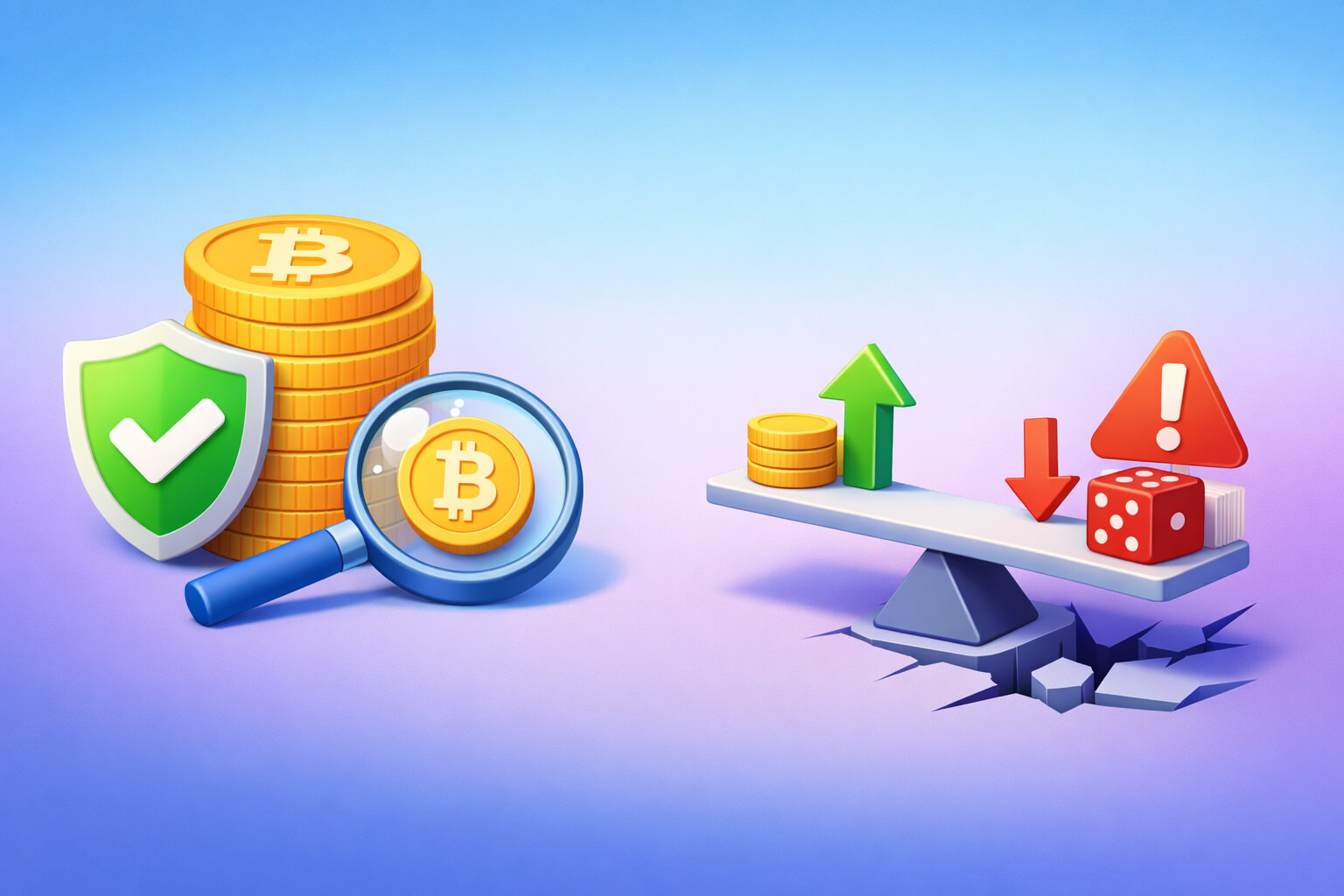
How Much Risk Is Too Much? A Beginner’s Guide to Safe Crypto Investing
Cryptocurrency has gone from a fringe experiment to a mainstream financial asset in less than fifteen years. Today, 28% of Americans own some form of digital currency, and institutions managing trillions of dollars are allocating portions of their portfolios to Bitcoin and Ethereum. The conversation is no longer “is crypto real?” It is “how much should I have, and how do I not get burned?”
That is exactly what this guide answers. Not with hype, not with fear, but with the kind of practical framework a professional investor would use before putting a single dollar to work.
What Makes Crypto Risky in the First Place
Every investment carries risk. What makes crypto different is the type and scale of that risk.
When you buy shares in a company like Apple or Johnson and Johnson, your investment is backed by real earnings, regulated disclosures, and legal protections. If your broker goes under, the Securities Investor Protection Corporation covers up to $500,000 of your account. None of those safety nets exist in the crypto world.
Crypto prices are driven primarily by sentiment, not fundamentals. A single post from a well-known tech billionaire can send a coin up or down 20% in hours. In March 2025, Bitcoin dropped 12% in a single day following a regulatory announcement from the U.S. government. Smaller altcoins routinely swing 50% or more within hours.
Beyond price swings, there are risks that most beginners never think about: scams, exchange collapses, wallet hacks, and outright fraud. Bad actors use Ponzi schemes, pump-and-dump tactics, phishing attacks, and romance scams to drain accounts. Once your crypto is gone, it is almost always gone for good. There is no fraud department to call, no chargeback to file.
Understanding this is not meant to scare you away. It is meant to ensure you go in with your eyes open.
How Much of Your Money Should You Put In?
This is the most important question in crypto investing, and the answer is simpler than most people expect.
Never invest more than you can afford to lose completely.
For beginners, the widely recommended range from financial experts is 5% to 10% of your total investment portfolio in crypto. If you have $10,000 invested across stocks, bonds, and savings, that means putting $500 to $1,000 into crypto at most. Many advisors suggest starting even smaller, with as little as $100 to $500, just to learn how the market feels before increasing exposure.
Before you invest a single dollar in crypto, you should already have three to six months of living expenses saved in an emergency fund. Crypto is not a savings account. It should sit on top of a financial foundation, not underneath it.
The reason for this discipline is simple: even the most established cryptocurrencies can lose half their value in a matter of weeks. If that loss would change your life, your position is too large.
Crypto vs. Other Investments: A Side-by-Side Look
One of the most useful things you can do before investing is understand exactly what you are trading off compared to other asset classes.
| Investment Type | Avg. Annual Return | Volatility Level | Government Protection |
|---|---|---|---|
| Crypto (BTC/ETH) | ~76% annualized over 10 years | Very High | None |
| S&P 500 Stocks | ~10 to 12% | Moderate | SIPC up to $500,000 |
| Real Estate | ~6 to 8% | Low to Moderate | Varies by structure |
| Government Bonds | ~2 to 4% | Very Low | Full federal backing |
The numbers tell an interesting story. A crypto-focused portfolio delivered approximately 76% annualized returns over ten years, compared to roughly 12% for the S&P 500 over the same period. But those returns come with dramatically higher volatility.
What the table above does not show is the stomach it takes to hold through a 50% or 60% drawdown without selling. Most beginners sell at exactly the wrong time, locking in losses right before a recovery. The returns are real, but they belong to investors who stayed patient and disciplined.
The Biggest Risks Most Beginners Ignore
Price volatility gets all the headlines, but it is not always the risk that hurts beginners the most. The ones that cause the most damage are the risks that feel invisible until it is too late.
- Scams and fraud are rampant in the crypto space. Bad actors run Ponzi schemes, pump-and-dump tactics, phishing attacks, romance scams, and “pig butchering” schemes, exploiting the pseudonymous nature of crypto transactions. Once funds are sent, they are generally impossible to recover.
- Exchange risk is real and often underestimated. When the FTX exchange collapsed in 2022, billions of dollars belonging to everyday investors vanished overnight. An exchange is not a bank. Funds held on one are not insured.
- Altcoin risk is where most beginners lose the most money. Studies show that 95% of altcoins eventually go to zero. New coins are launched constantly, many with nothing behind them except marketing. The promise of the next 1,000x return has cost countless investors their savings.
- Regulatory risk continues to evolve. A government announcement in one major country can shift prices globally within minutes. Even in the United States, where regulation has become friendlier in 2025 and 2026, the rules governing crypto are still being written.
The pattern across all of these risks is the same: they hit hardest when investors are chasing hype instead of following a plan.
How to Build a Safer Crypto Portfolio
Building a safer portfolio is less about finding the right coins and more about following the right habits consistently.
- Start with Bitcoin and Ethereum. They are the most established, most liquid, and have the longest track record. Many experts suggest a starting allocation of roughly 40% Bitcoin, 30% Ethereum, and no more than 30% in other established cryptocurrencies.
- Use dollar-cost averaging. Invest a fixed amount on a regular schedule, such as $50 or $100 every week, regardless of price. This removes emotion from the decision and means you automatically buy more when prices are low.
- Use regulated exchanges only. Platforms like Coinbase, Kraken, and Gemini operate under regulatory oversight and offer meaningful security features. Traditional brokers like Fidelity now offer crypto trading as well, with familiar protections.
- Enable two-factor authentication on every account, without exception.
- Do not keep large amounts on an exchange long-term. Move significant holdings to a personal hardware wallet where only you control the private keys.
- Avoid memecoins, unknown altcoins, and anything promoted aggressively by influencers. Influencers can create buzz around a token, and retail investors who follow blindly usually lose money, making independent research critical.
- Build your emergency fund before you invest anything. Crypto belongs at the speculative edge of your finances, not at the core.
How to Spot a Scam Before It Gets You
The crypto space attracts more fraud than almost any other investment category. Knowing the warning signs before you encounter them is one of the most valuable things you can learn.
Any investment that promises guaranteed returns is a scam. There are no guaranteed returns in crypto. If someone is pressing you to act quickly before a window closes, that urgency is manufactured. Legitimate investments do not disappear in 24 hours.
Watch for projects with no published whitepaper, anonymous development teams, or no verifiable liquidity. These are classic signs of a “rug pull,” where developers vanish with investor funds the moment enough money has been raised.
Be especially cautious with unsolicited contact. Romance scams, also called pig butchering scams, have become one of the most common forms of crypto fraud. They typically begin with a friendly message, build a sense of trust over weeks or months, and then introduce a “once-in-a-lifetime investment opportunity” that drains everything.
If something feels too good to be true, the safest move is to walk away. In crypto, the cost of being wrong about a scam is almost always permanent.
The Tax Side Nobody Talks About
Most new investors think about buying crypto. Very few think about what happens at tax time.
In most countries, including the United States, crypto is treated as a taxable asset, not a currency. That means every time you sell, trade, or use crypto to make a purchase, it is a taxable event. If you sold Bitcoin for a profit, that profit is subject to capital gains tax. If you traded one coin for another, that is also a taxable event, even if you never converted back to dollars.
In many countries, all cryptocurrency gains must be reported as income, and failure to do so can result in tax penalties or audits.
The practical implication is straightforward: keep records of every transaction from the very beginning. Note the date, the amount, and the price at the time of purchase and sale. Tax reporting tools like Koinly or CoinTracker can automate much of this by connecting directly to your exchange accounts.
Sorting out years of untracked transactions is painful and expensive. Getting organized from day one costs nothing.
Are You Ready to Invest? A Simple Self-Check
Before you buy anything, answer these questions honestly.
Do you have three to six months of living expenses saved and accessible? If not, crypto is not the right next step. Build that cushion first.
Could you lose the amount you are planning to invest without it affecting your rent, bills, or daily life? If the answer is no, the amount is too large.
Do you understand what Bitcoin and Ethereum actually are, at a basic level? You do not need to be a technologist, but you should understand what you are buying.
Are you investing because you have done research, or because you saw something on social media and felt like you were missing out? Fear of missing out is one of the most reliable predictors of poor investment outcomes.
Do you have a plan for when to hold and when to sell? Without a plan, emotions make the decisions, and emotional decisions in a volatile market almost always cost money.
Of Americans who have ever owned crypto, 53% report a positive return, but 21% have experienced a net loss. The difference between those two groups often comes down not to which coins they picked, but to whether they had a clear strategy and stuck to it.
If you can answer all of the questions above honestly and still want to proceed, you are starting from the right place. Crypto can be a legitimate part of a diversified financial strategy. The key word is part. Keep it in proportion, protect your position with good habits, and never let the excitement of the market override the discipline of your plan.